
Nicolaus Copernicus
In Toruń, Copernicus is ubiquitous – in the streets, buildings, institutions, art, and the city's unique atmosphere. Follow in the footsteps of this astronomical and mathematical genius, learn about his achievements, and be inspired by the places that influenced his life. Toruń combines history, science, and the joy of living, creating unforgettable experiences.
 |
Nicolaus Copernicus quick facts:
Nicolaus Copernicus (Mikołaj Kopernik; 1473-1543) - astronomer, mathematician, economist, physician, clergyman - a versatile Renaissance man; the greatest and most famous Toruń native, one of the most eminent scientists in human history. Today, Copernicus is one of Toruń's greatest assets, not only for tourism, and the most common association with the city. Copernicus was, above all, an astronomer - he introduced the heliocentric theory to modern science, which was a breakthrough and sparked one of the most important scientific revolutions in human history, known as the Copernican Revolution. His theory informed the development of modern natural science, and his work began to straighten the twisted paths of existing science. However, Copernicus also became famous in connection with other fields of science. He was born on February 19, 1473, in one of the houses belonging to the Copernicus family (ul. św. Anny – now ul. Kopernika no. 15 or Rynek Staromiejski no. 36), but no specific location is known. This is one of several unknowns about the astronomer. We know his works, oeuvre, and life in detail, but there are a few minor details that raise significant doubts. Was he Polish? German? What did he really look like? Did he only study in Toruń before starting his studies? Where is he actually buried? |
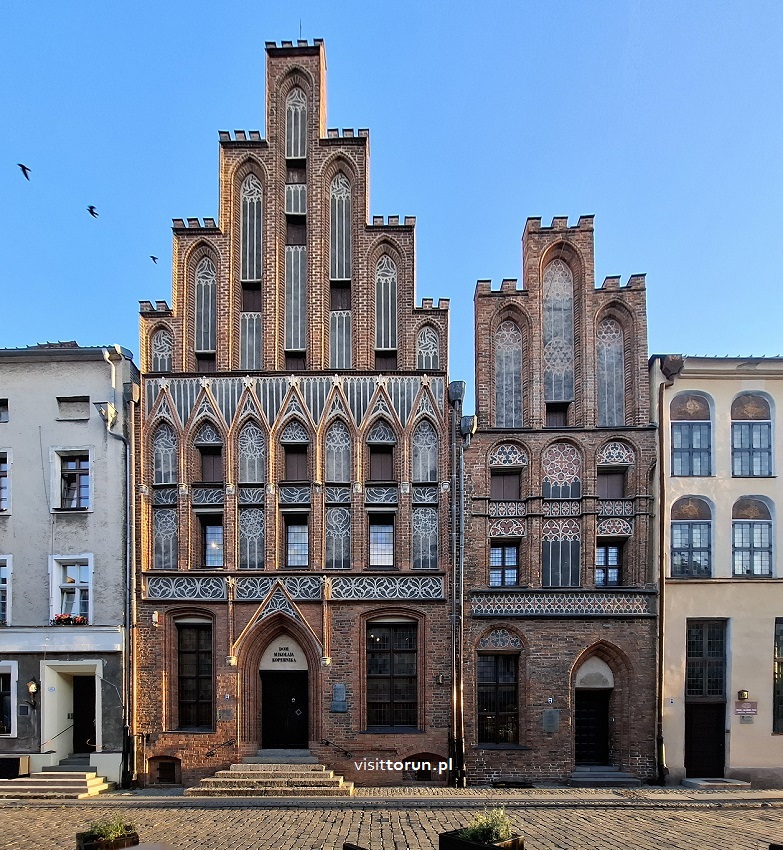
A journey in the footsteps of Nicolaus Copernicusbegins at his birthplace: the Copernicus Family Home, red and Gothic, of course. Then, visit the Copernicus Chapel in St. John's Cathedral, with its numerous Copernicus memorabilia: the baptismal font where the future astronomer was baptized, the first expression of the astronomer's memory in the form of an epitaph plaque from 1589, and a marble bust of Copernicus from 1766, the oldest monument to him in the world. However, the most famous monument to Nicolaus Copernicus stands in the central and most important place in the city - in the Old Town Square. A significant element of the great cult and tradition of Nicolaus Copernicus is the Nicolaus Copernicus University Astronomical Observatory (with one of the world's largest radio telescopes, capable of pinpointing the location of a cell phone on the Moon to within a few meters), but also the Nicolaus Copernicus University itself in Bielany – the largest and oldest academic institution in northern Poland, with a highly regarded Faculty of Law and Administration, a Faculty of Physics and Astronomy, and the only university Faculty of Fine Arts in Poland with world-renowned monument conservators. The Nicolaus Copernicus University is also the only secular university to have hosted Pope John Paul II. |
 Guided Tour The Spirit of Copernicus in Toruń |


