Copernicus memorabilia and places in Toruń
|
Toruń's astronomical tradition is rooted in the legacy of Nicolaus Copernicus, the greatest astronomer and Toruń native, which today practically obliges the presence of this science in his hometown. It's therefore impossible to imagine Toruń without institutions such as: The Planetarium, the Nicolaus Copernicus University Astronomy Centre (with its large astronomical observatory), The Nicolaus Copernicus Astronomical Centre of the Polish Academy of Sciences, the Polish Astronomical Society (established in Toruń in 1923, bringing together scientific astronomers), The Polish Society of Amateur Astronomers (bringing together amateur astronomers). Of course, in most cases, these are scientific institutions. However, tourists visiting Toruń can certainly get close to and touch great astronomy in this "astronomical" city. For this very purpose, there is a Planetarium, where programs are presented on a special dome imitating the celestial vault, and at the Nicolaus Copernicus University Astronomy Centre, visitors can observe astronomers at work. It's perfectly prepared for sightseeing, allowing you to explore everything in detail without interruption. In the interactive Geodium room at Planetarium, you can learn about various natural phenomena occurring on planet Earth. We also invite you to take a guided tour of the famous astronomer and Toruń's most famous citizen, exploring places and mysteries associated with Nicolaus Copernicus and Toruń's astronomical attractions >>> |
|
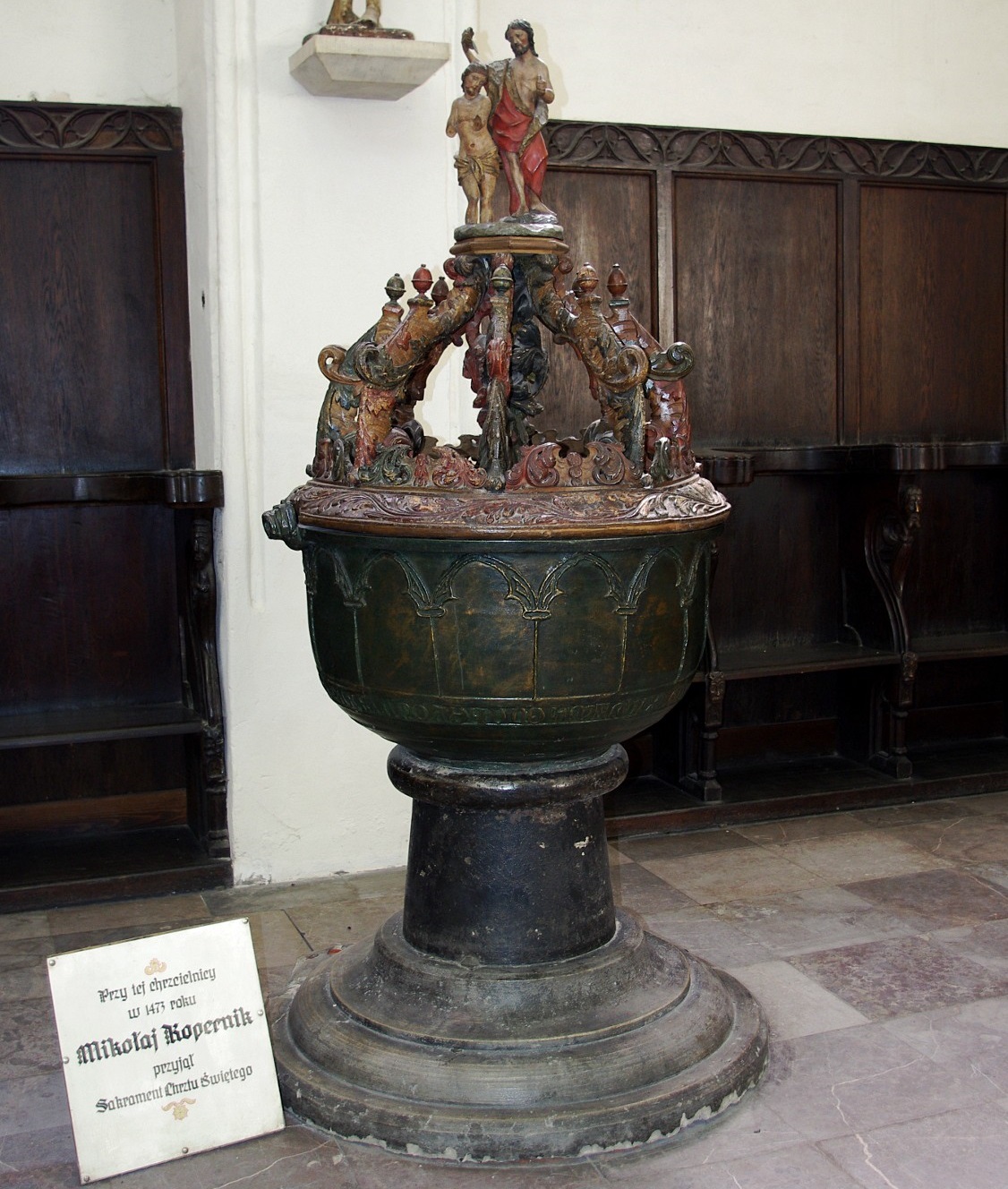
A place particularly associated with Copernicus, and the first chronologically linked to him, is the Cathedral of St. Johns', and especially the side Chapel St. Nicholas (Copernican Chapel). There stands an early Gothic baptismal font from the 13th century, in which Nicholas was baptized in 1473. The main part of the baptismal font, both for its liturgical and artistic function, is cast from a precious metal alloy: bronze with an increased addition of tin. It is shaped like a wide, flattened chalice. The bowl is set on a cylindrical stone shaft supported by a profiled, circular base. The bowl of the baptismal font is made in a clay mold – a method used since the 12th century in bell casting. The lower part is encircled by a Latin capital letter, but it is impossible to read logically. The surface of the bowl is also covered with Gothic decoration in the form of arcades with empty fields, culminating in an arch with a trefoil motif inscribed within it. |
 |
|
| Even in the Middle Ages, Toruń hadn't forgotten Copernicus, even though it took a dozen years for the brilliant astronomer's fame to reach his hometown. The first act of tribute to his memory was the foundation by Melchior Pirnesius, a city physician and humanist, around 1580 of a symbolic epitaph in the Chapel of St. Nicholas in the Cathedral of St. Johns', featuring a portrait of the great astronomer, modeled after his supposedly "real" image from the sundial on the tower of Strasbourg Cathedral. This epitaph can still be seen today. This famous "real" portrait of Copernicus from Strasbourg is now perhaps the oldest surviving likeness of the great scientist in the world. It was painted around 1574 by Tobias Stimmer, but significantly repainted in the 19th century to resemble the Toruń portrait of Copernicus . Copernicus' epitaph in St. Johns' Cathedral depicts a bust of the astronomer facing right, hands folded in prayer, wearing a cassock with a red outer robe. The bust is set in a chamber from which a window view, highlighted by a large cross in the foreground, depicts a hilly landscape. In the upper right corner, a shelf containing an astrolabe and compass is visible. Below the bust is a Latin inscription, translated as: "I do not ask for a grace equal to that of St. Peter, nor for forgiveness like that which Peter received, but for such forgiveness as you granted the thief on the cross, I continually beg." The Latin inscription below on the frame speaks of the epitaph's creation as a token of appreciation and "...so that the memory of such an illustrious man, the greatest in foreign lands, may not perish in his own homeland, surrounded by glory..." | 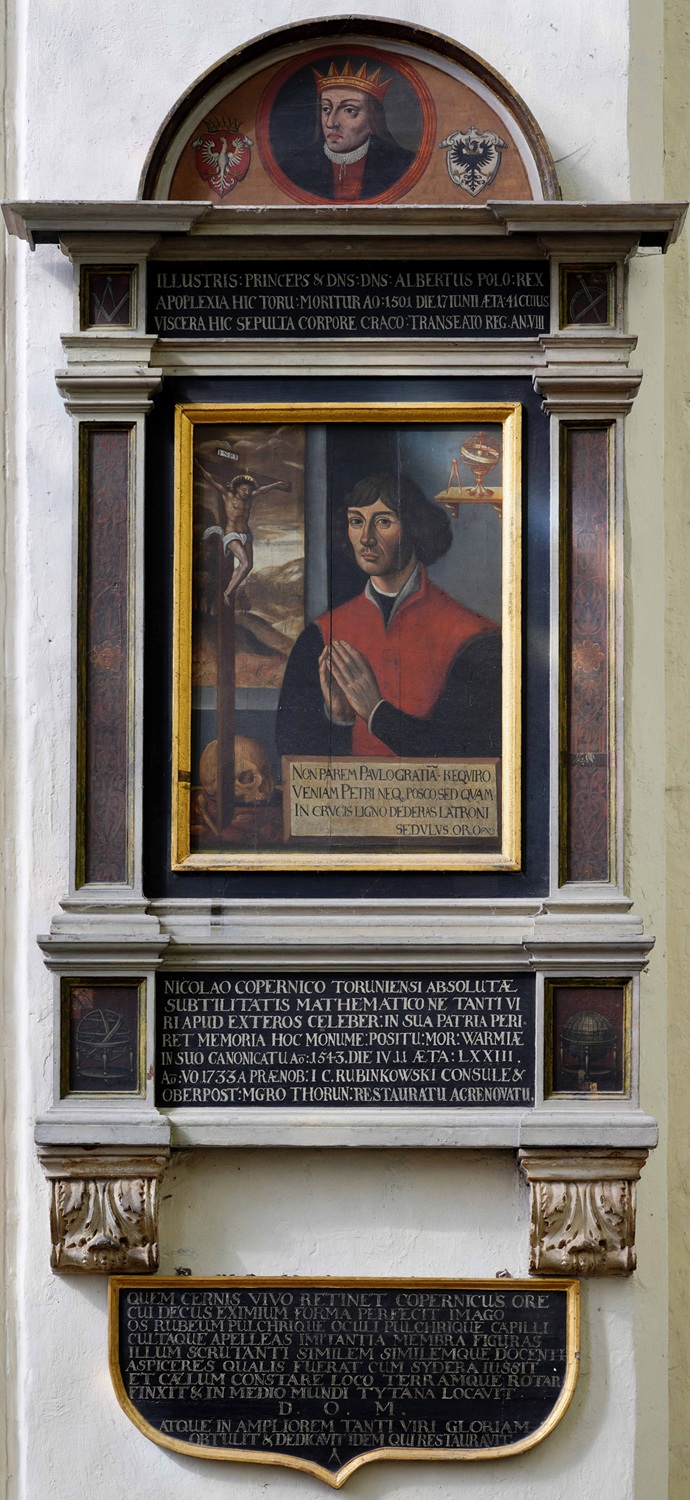 |
|
| A similar commemorative function is served by the most famous of the early images of Copernicus – a widely distributed portrait from the second half of the 16th century, formerly hanging (at least since 1594) in Toruń's famous Academic Gymnasium. The painting depicts a bust of the astronomer, aged approximately 35-40, dressed in canonical garb - a dark robe over which is worn a sleeveless, red robe lined with fur. This outstanding work of Southern Netherlandish painting, currently on display in the Toruń Burgher Portrait Gallery in the Old Town Hall, has numerous copies and is anonymous (although some scholars claim it was created by the Netherlandish painter Marcus Geeraerts). Its origins, authorship, time and circumstances of creation, and purpose remain unclear. However, of all other images of Copernicus, this one is undoubtedly of the highest artistic quality, represents a high standard, and may serve as a model for them. |  |
|
| After years of diminishing interest in Copernicus in the 17th and 18th centuries, due to the inclusion of his work "De revolutionibus orbium coelestium" on the Index of Forbidden Books, it is worth noting that in 1766, the Prince Józef Aleksander Jabłonowski, donated a modest bust of Copernicus (>>>), carved in marble by the Kraków sculptor W. Rojowski. This is the oldest monument to Copernicus in the world. Due to the bust's low artistic value, it was stored for a long time - at the behest of Toruń City Council - in the Old Town Hall, not on public display (according to the founder's suggestion, the monument was to be placed in the northern part of the Old Town Market Square). Around 1780, Princess Izabela Czartoryska tried to acquire the bust for the museum that was then being established in the town of Puławy. Only at the beginning of the 19th century, at the initiative of Stanisław Staszic, was the bust placed in the Church of St. Johns', where it stands to this day, also in the Chapel of St. Nicholas (Copernican). | 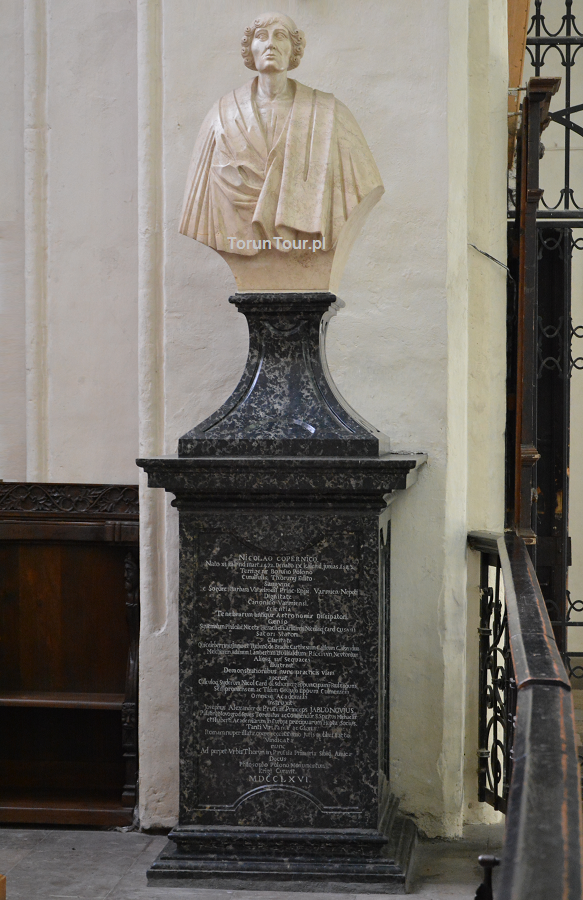 |
|
| The initiative to erect a representative Copernicus monument in Toruń in the Old Town Market Square, in front of the southeast corner of the Old Town Hall, was taken by members of the Council of State of the Duchy of Warsaw, who laid the cornerstone while meeting there in 1809. The project was not implemented until much later, in 1853. >>> | 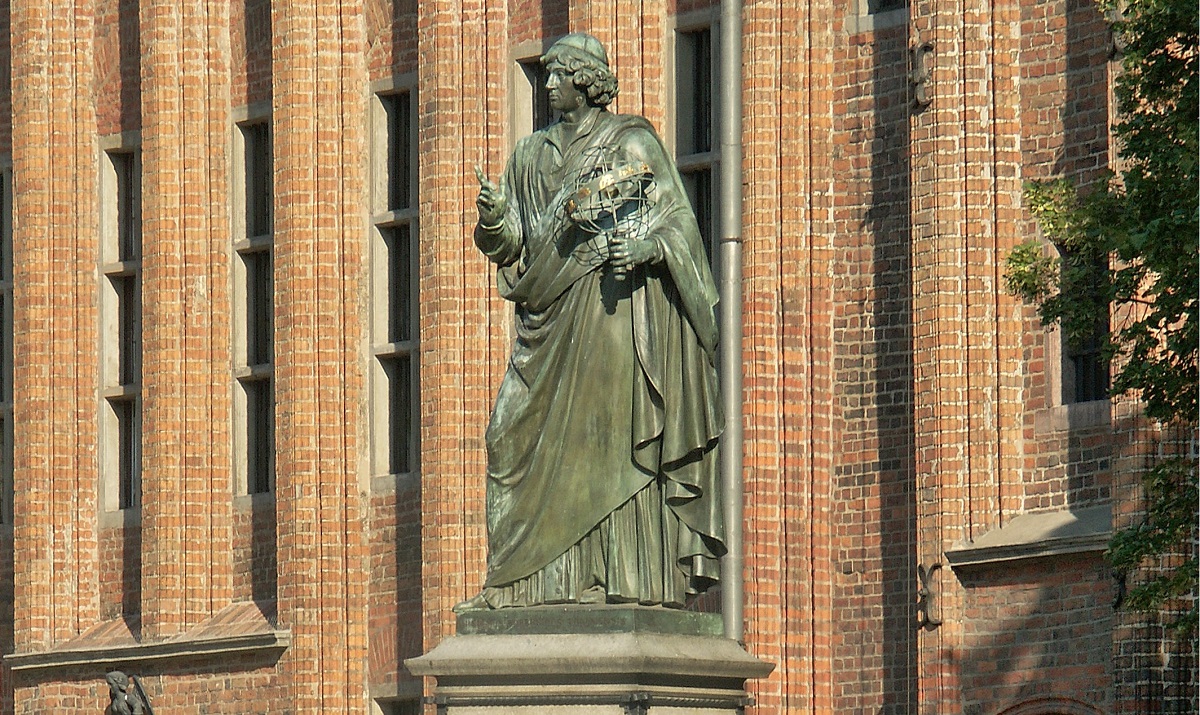 |
|
| In 1871, the Toruń scientific society Coppernicus-Verein für Kunst und Wissenschaft funded a commemorative plaque in German, placed in the alleged Copernicus House at 40 Kopernika Street, proclaiming that Nicolaus Copernicus was born there (the house was visited by Napoleon in 1812 and Frederic Chopin in 1825, among others). This materially and publicly perpetuated the error of identifying the wrong tenement house as the Copernicus family home, which dates back to the 18th century. Ten years after the plaque was hung, the error was discovered and challenged by Mayor Georg Bender, relying on city archives, who pointed to the tenement house at 17 Kopernika Street, which remains recognized today. In 1923, on the 450th anniversary of Copernicus's birth, a Polish commemorative plaque was unveiled here. The German plaque from the wrong house was removed only in 1933 during the town's preparations for the celebrations of the 700th anniversary of its granting of city rights and kept in a museum; in 1939 the Germans put it back in place, only to take it away in 1945, and removed the Polish plaque from the house at number 17. |
Napoleon in front of the alleged house of Copernicus in 1812 |
|
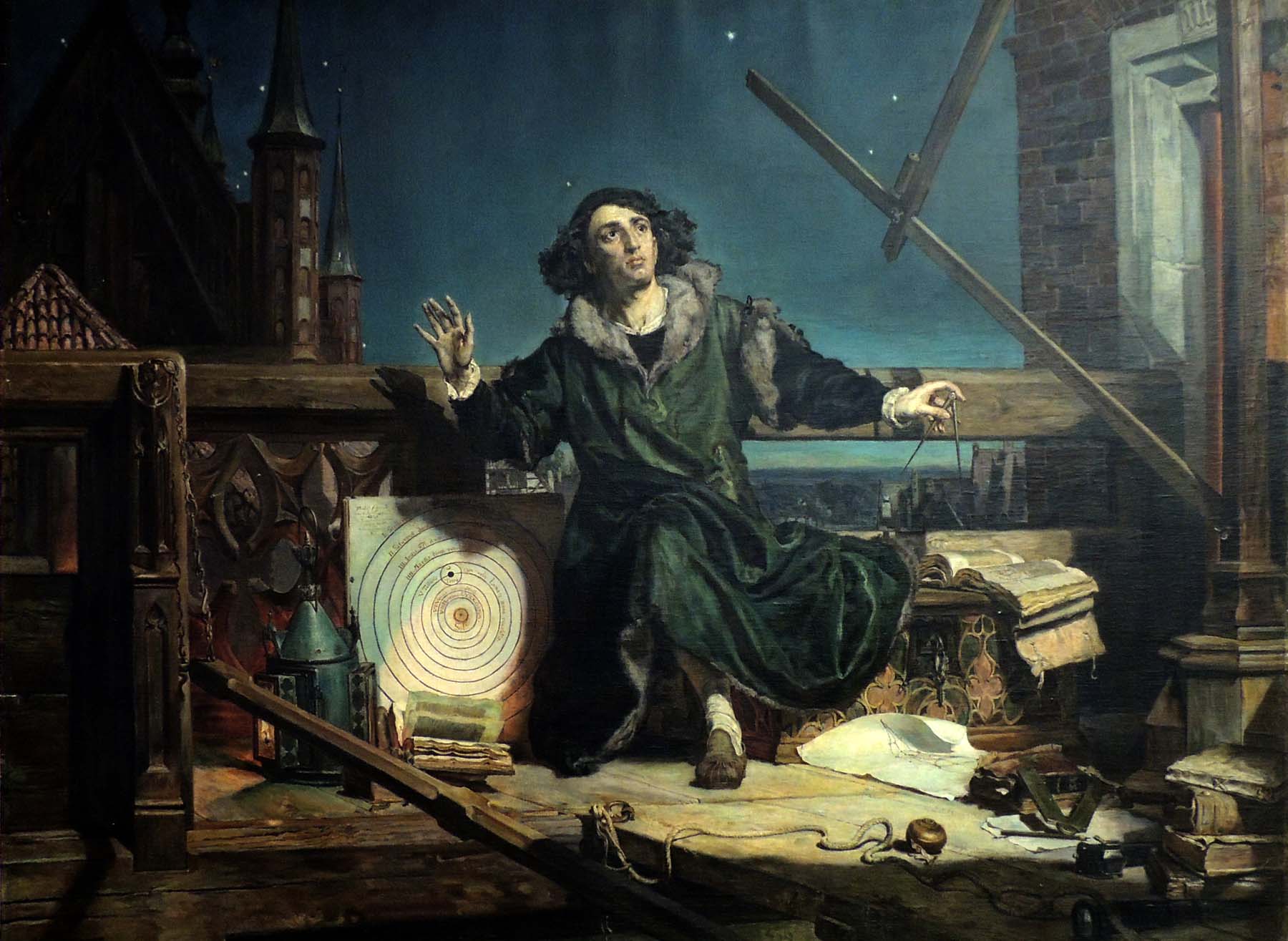
| For the 400th anniversary of Copernicus's birth, celebrated in Toruń in 1873, two separate celebrations were planned: a Polish one (organized by the Society of Moral Interests) and an official German one, held at the Artus Court, the Old Town Hall, and the Gymnasium. For the Polish celebrations, Jan Matejko painted a portrait of the astronomer, which, according to the master's promise, was to be exhibited in Toruń to enhance the occasion. However, the Kraków city authorities, organizing the anniversary celebrations at their own venue, kept the painting in place. The work is now housed at the Jagiellonian University Museum in Kraków. Nevertheless, a biography and an album of the astronomer's monuments and portraits were published in Toruń for the occasion, and a commemorative medal was minted. In the newly constructed building of the Scientific Society in Toruń, among the collection of plaster busts of Polish rulers and famous Poles donated to the Society, a bust of Copernicus was also included. |
 |
|
|
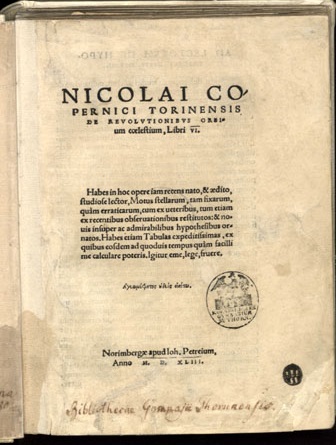
In addition to the artistic works that are an expression of the cult of the Great Toruń native, especially noteworthy are the editions of his works, with the oldest one from Nuremberg (1543) at the forefront, as well as a collection of old prints that continue the path blazed by Copernicus, carefully preserved in the collections of the Copernican Library, the University Library, and the Copernicus Museum. In Copernicus's hometown, two copies of the first edition of his greatest work, De revolutionibus orbium coelestium, are kept. One of them, with a very interesting history, is part of the University Library (Biblioteka Uniwersytecka) collection, the other of the Copernicus Library (Książnica Kopernikańska). |
 |
|
|
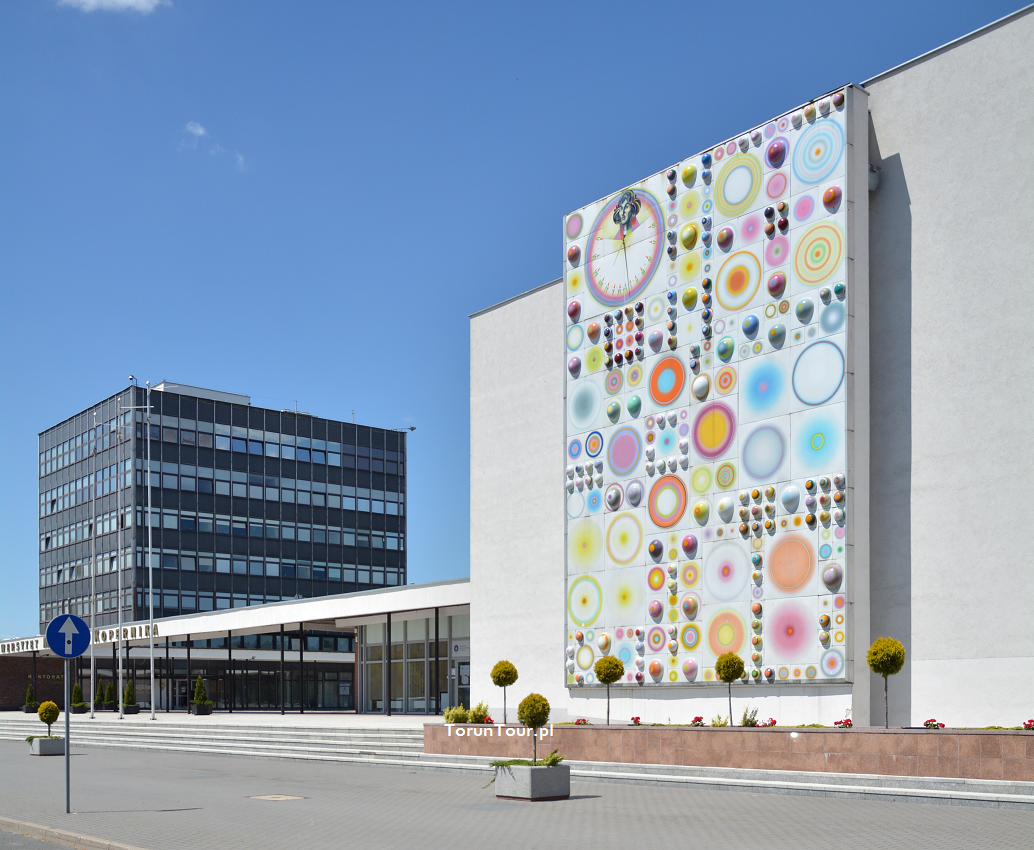
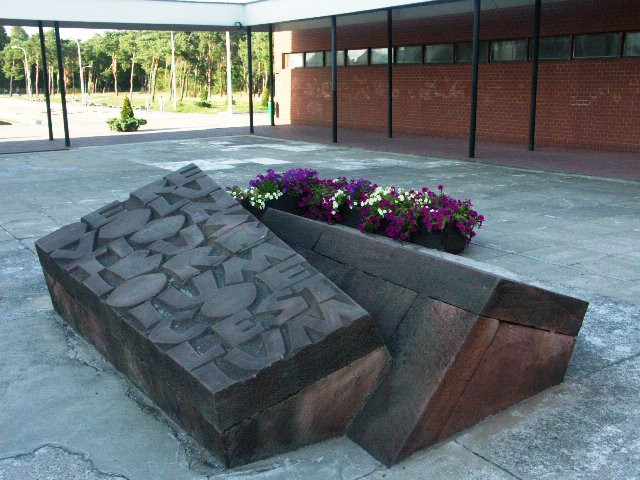
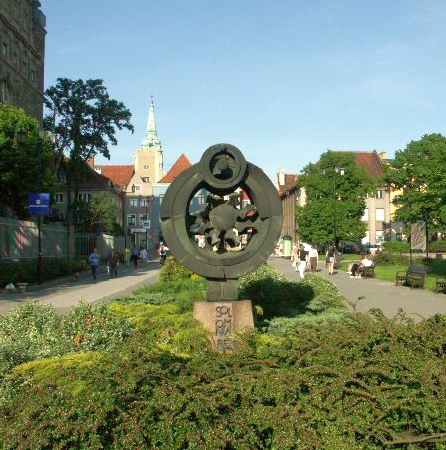
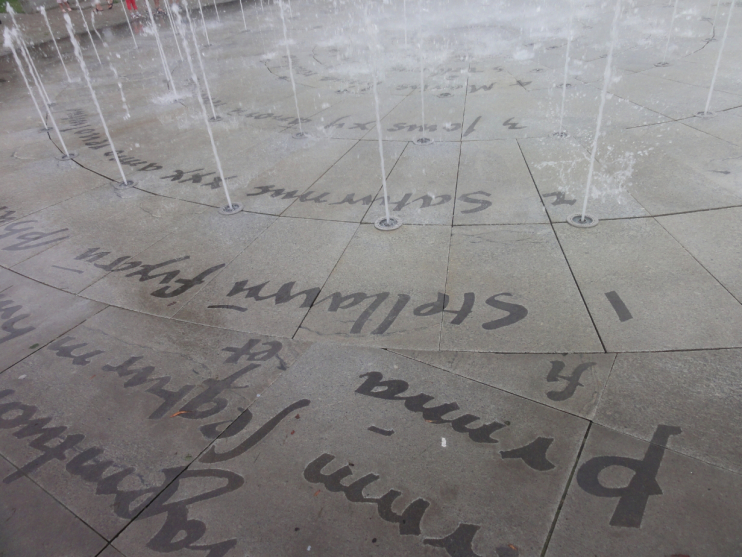
After World War II, various efforts were made to commemorate Copernicus. The establishment of Nicolaus Copernicus University by decree of the State National Council on March 14, 1945, contributed to the creation of a major scientific and cultural center in Toruń, the largest and oldest university in northern Poland. In connection with the 500th anniversary of Copernicus's birth in 1973, Toruń, pursuant to a resolution of the Council of Ministers, was the venue for the inauguration of the celebrations associated with this important anniversary. In preparation for the Copernican Year, numerous lasting investments were made in the city. The most important of these was the restoration - through appropriate conservation measures - of many of the monuments in the Old Town, which had witnessed Copernicus's childhood. In addition, the Nicolaus Copernicus University (NCU) campus in Bielany district was built as a uniformly shaped academic campus, featuring memorabilia such as a sculpture stylized as the book De revolutionibus... located near the NCU main auditorium; a composition of the celestial firmament with a portrait of Copernicus and a sundial on the auditorium wall; and a copy of the scholar's portrait from the Academic Gymnasium in the rector's office. The astronomer's family house, restored between 1960 and 1963 and 1972, became the Copernicus Museum (which, on its fortieth anniversary (celebrated in 2000), received a valuable gift - the Amsterdam edition of "De revolutionibus..." from 1617). In 1973, the "Helios" monument in honour of Copernicus was unveiled in Rapackiego Square, representing the essence of the Copernican system. A unique Copernican memento - a reference to the eighth page of Copernicus's work "De revolutionibus...", which depicts the heliocentric system - is the Cosmopolis Fountain (>>>) in the Planty Park. The fountain has 113 water jets arranged in the orbits of Mercury, Venus, Earth, Mars, Jupiter, and Saturn. The central jet, placed in place of the Sun, shoots water to a height of 5 meters, while the orbiting jets shoot water up to 4.5 meters. The electronically controlled fountain presents sound and light shows several times after dusk during the tourist season. Tourists and locals can hear, among other things, Krzesimir Dębski's piece "Cosmopolis," written especially for the fountain. The composition is 15.5 minutes long. |
|