Life and Work of Nicolaus Copernicus
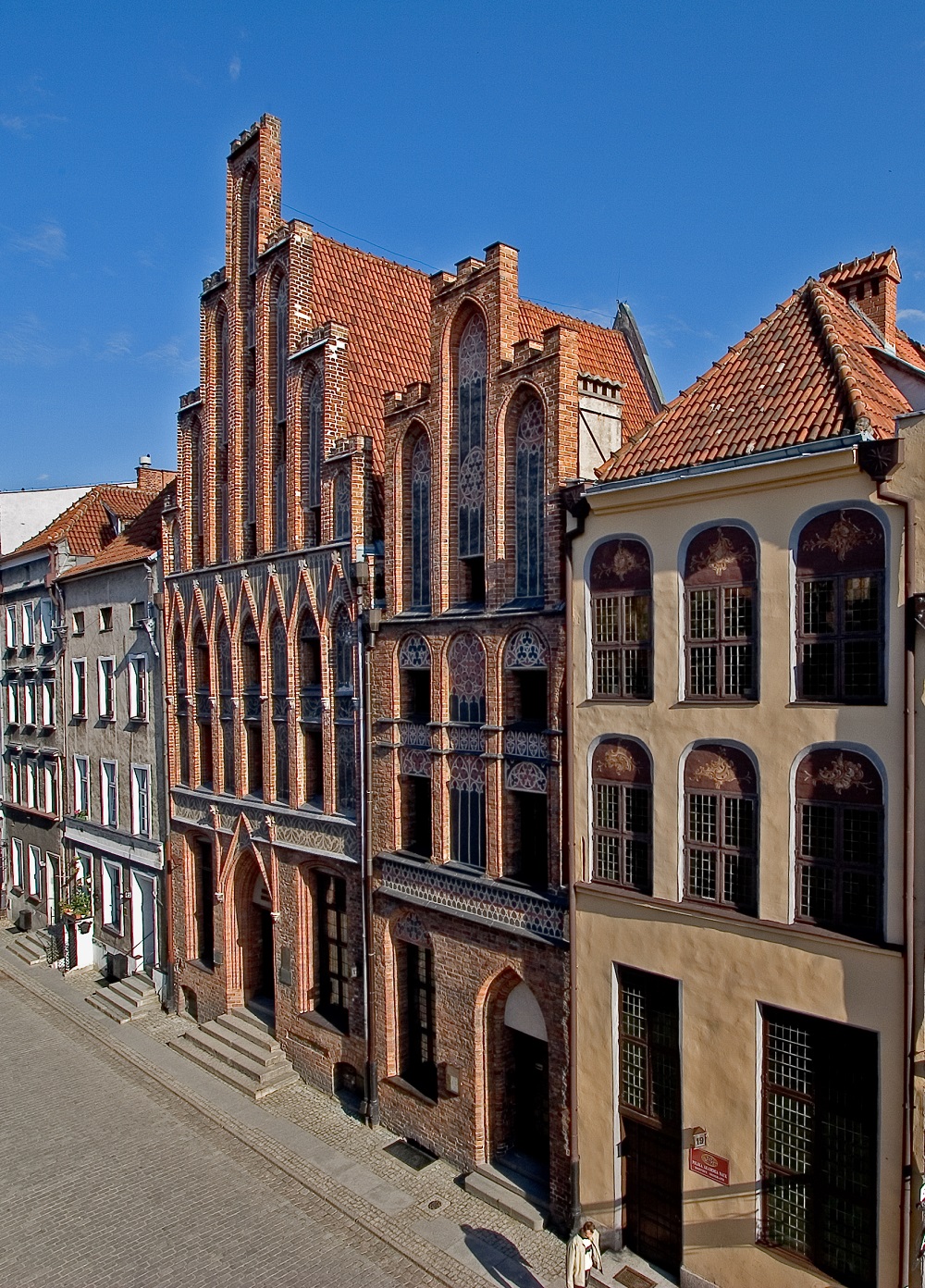 Nicolaus Copernicus was born on February 19, 1473, in one of the houses belonging to the Copernicus family, at St. Anne Street (known as Copernicus' House), the street that bears his name today, or in house at No. 36 Old Town Market Square.
He came from a merchant family. His father - also Nicolaus - came from Kraków. After arriving in Toruń, he married Barbara from the local Watzenrode patrician family, which allowed him to enter the wealthy and influential Toruń patrician circles. The Copernicus family had four children: Andrew, Barbara, Catherine, and the youngest, Nicolaus.
Young Nicolaus spent his childhood and youth in Toruń. Here, the beginnings of his multifaceted personality were formed, fueled by the unique atmosphere of a vibrant city that hosted - due to its commercial nature - merchants from various countries, who, while also staying at the Copernicus family home, shared their various observations, arousing the curiosity of the future astronomer.
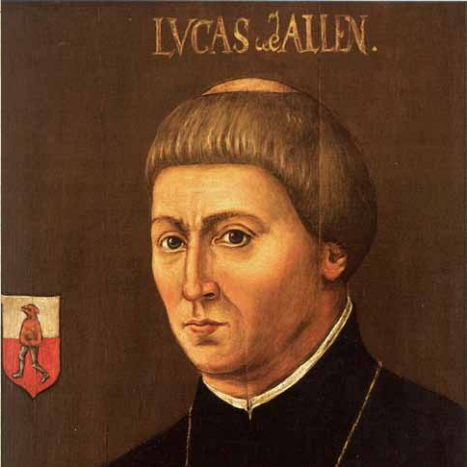 In his hometown, Copernicus began his education at the municipal school at the Church of St. Johns, located on School Street - now St. John Street. Research has shown that the school offered a high standard of education, boasted a group of distinguished professors (one of its rectors was the renowned humanist Konrad Gesselen and Lucas Watzenrode (de Allen)- Copernicus's uncle, later Bishop of Varmia and patron of Nicolaus Copernicus) and a rich collection of books, including manuscripts and works on astronomy and astrology. It is possible that Copernicus acquired his initial interest in the sciences from this school. It is uncertain, however, whether Copernicus attended this school until the age of 15 or 18.
The death of his father in 1483, who later experienced financial difficulties, left the family impoverished. His uncle (his mother's brother), Lucas Watzenrode, then took over the care of his mother and Nicholas. It was on his initiative and with his support that Nicolaus Copernicus began his studies at the age of 18.
From 1491 to 1495, he and his brother Andrzej studied at the Faculty of Liberal Arts at the Kraków Academy, where mathematics and astronomy were among the highest caliber. The following entry can still be seen in the enrollment register for the winter semester of 1491/1492: "Nicolaus Nicolai de Thuronia solvit totum," meaning: "Nicolaus, son of Nicholas of Toruń, paid everything." So Nicolaus Copernicus was accepted into the faculty and paid the full tuition fee at once. From 1496, he studied astronomy in Bologna and from 1501, law and medicine in Padua; in 1503, he earned a doctorate in canon law in Ferrara. At the end of 1503, he returned to Poland, to Varmia. He never settled permanently in Toruń again. From 1504 to 1510, he served as secretary and personal physician to his uncle, Bishop Lucas Watzenrode of Varmia, and resided primarily in Lidzbark Warmiński. In 1509, he published his Latin translation of the Greek letters of Theophylactus Simocatta in Kraków. In 1510, as a canon and chancellor of the chapter, he settled in Frombork, where he conducted astronomical observations and wrote his principal work. From 1516 to 1519 and in mid-1521, he served as administrator of the chapter estate in Olsztyn. During the Polish-Teutonic War of 1520-1521, he defended Olsztyn Castle against the Teutonic Knights.
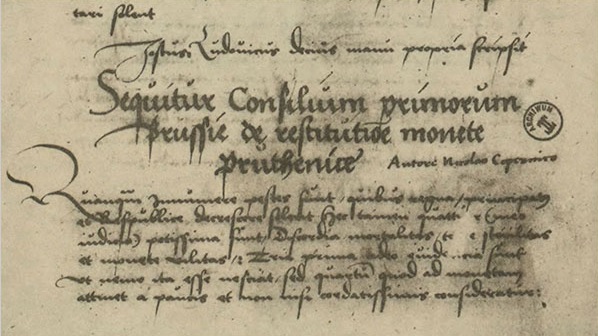 While residing in Lidzbark Warmiński, Copernicus served as administrator of the Varmia chapter estate and, inevitably, had some experience with economics. His interest in economics led to his project for currency reform (1517). A memorandum on this matter, presented to the Prussian sejmik (local parliament) in Toruń in 1519, was expanded and compiled by Jôst Ludwig Decius in 1526 into a treatise entitled "Monetae cudendae ratio" ("On the Method of Minting Coins"). Earlier, however, in 1522, at the Congress of the Prussian Estates in the town of Grudziądz, Copernicus presented his treatise on the reform of Prussian coinage. It formulated the principles of monetary reform based on a project to improve the currency and standardize the Prussian and Polish coinage. He formulated the economic law according to which inferior money drives out superior money. This law was later called Gresham's Law, to which his discovery was attributed.
Ultimately, based on the currency reform of 1526-1528, a crown mint operated in Toruń.
However, Copernicus devoted all his free time to working on his life's work. Around 1510, he outlined the heliocentric theory in a treatise known as "Commentariolus." This was not published but circulated throughout Europe in copies, two of which were not discovered until the 19th century.
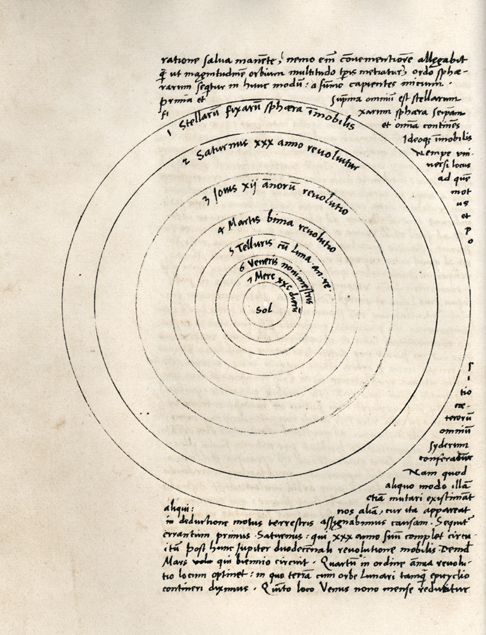
De Revolutionibus Orbium Coelestium
(On the Revolutions of the Heavenly Spheres)
|
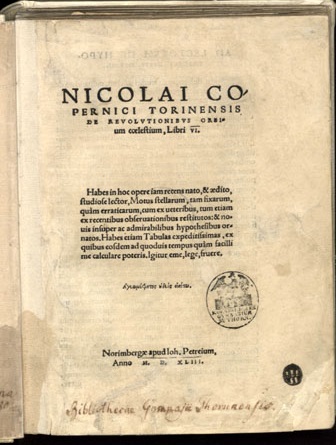
Copernicus's principal work, "De revolutionibus orbium coelestium," containing an exposition of astronomy in terms of the Earth's rotation on its axis and its orbit, along with the other planets, around the Sun, was written between 1515 and 1530 in the town of Frombork. Although Copernicus chose not to publish the results of his scientific investigations, and only in 1535, at the initiative of B. Wapowski, compiled an almanac (now lost) based on the astronomical tables from "De revolutionibus...", news of this theory of the world spread throughout Europe. It also reached Georg Joachim von Lauchen, known as Rheticus, a German mathematician and astronomer at the University of Wittenberg. In 1539, he came to Frombork to familiarize himself with Copernicus's work, and then together they traveled to Lubawa town, where he stayed at the castle of the Chełmno bishops for over two summer months. Rheticus became an enthusiast of Copernicus's theory. This prompted him to publish the work. An extract from it, known under the abbreviated title "Narratio Prima," prepared by Rheticus, was published in Gdańsk in 1540. In 1541, Rheticus submitted Copernicus's work for publication in Nuremberg. Rheticus supervised the printing; without Copernicus's knowledge, he withdrew Copernicus's preface and replaced it with his own, unsigned one, presenting Copernicus's theory as a hypothesis that facilitated calculations. This was inconsistent with Copernicus's position, clearly stated in the Dedicatory Letter to Pope Paul III, printed at the beginning of the same book. The work was published in Nuremberg in 1543, under the name "Nicolai Copernici Torinensis" (Copernicus always emphasized his origins with the addition "Torinensis" - citizen of Toruń >>>), in an edition of 500 copies. That same year, on May 24th in Frombork, Copernicus died and was buried in the crypt of Frombork Cathedral. Copernicus's work, which challenged established views on the structure of the world, was not immediately well-received by both scholars and ecclesiastical authorities. However, from the turn of the 16th and 17th centuries, the theory gained increasing support, with Giordano Bruno, Johann Kepler, and Galileo Galilei contributing most to its consolidation. Even during Copernicus's lifetime, his theory met with fierce opposition from Martin Luther, Philip Melanchthon, and John Calvin, as contradicting the text of the Bible. The Catholic Church initially took no official stance on the theory, but later, after the Council of Trent, deemed it contrary to the worldview. In 1616, the Congregation of the Index issued a decree condemning "De revolutionibus...". The work was removed from the Index Librorum Prohibitorum only in 1758. The Copernican Revolution (as Copernicus's speech and work were later called) involved overcoming the long-held view, adopting the ancient idea of the heliocentric system (introduced to astronomy by Aristarchus of Samos), and creating a scientific foundation for this concept as complete and rigorous as was possible within the knowledge of the time. This was one of the most important scientific revolutions in human history. |
Manuscript of De Revolutionibus...
Subsequent editions:
|