
Nicolaus Copernicus, German? Pole? Toruń native!
This is the dispute between Polish and German scientists. Some argue for his German roots, others prove his Polish ancestry. They have been proving the great astronomer's origins for decades, at least since the late 19th century. They study archival documents and read his letters.
Meanwhile, Copernicus was neither Polish nor German; he neither felt Polish nor German. He was merely a German-speaking subject of the Polish king. He was a Prussian - but neither the Prussian from before the Teutonic Knights, nor the Prussian from the times of the German Kingdom of Prussia - but the one from the times of Royal Prussia. And as his uncle and advisor, Lucas Watzenrode, wrote:
Although this country, Prussia, is incorporated into the Polish Crown, this country, Prussia, is not the same country as Poland, nor are Prussians Poles, but a separate country with its own laws.
And as Professor Marian Biskup wrote:
For Gdańsk and Toruń, Royal Prussia was primarily the "Vaterland" or "gemeynes vaterland" of their inhabitants, who to themselves were "landsman" or "compatriot." For Nicolaus Copernicus, Prussia, the "republica Prussiana," was also his "dulcissima patria."
Norman Davies also wrote:
As a citizen of Royal Prussia, Copernicus never admitted to anything but local patriotism, which is why he referred to himself as a "Prussian."
Great efforts were made to prove and exaggerate the "Polishness" of people whose deeds were seen as a stimulus to the nascent nation's self-esteem. In the field of science, two prominent candidates for this role were Maria Curie-Skłodowska and Nicolaus Copernicus; in the field of literature, the English writer of Polish descent, Joseph Conrad; and in the field of music, finally, Fryderyk Chopin. For example, in 1893, preparations in Germany for the celebration of the four hundredth anniversary of the birth of the great German scientist Nicolaus Copernicus caused a huge stir, as Poles themselves were preparing to commemorate the birth of the great Polish scientist Nicolaus Copernicus. Polkowski's biography, published in Warsaw, aimed to challenge the conclusions of von Hipler's biography, published in Berlin, thus giving rise to a dispute that has raged with senseless passion ever since. The fact that both Copernicus himself and his contemporaries generally paid no attention to the issue of nationality was lost in the deluge of attacks and counterattacks. As a citizen of Royal Prussia, Copernicus never professed anything beyond local patriotism, thus referring to himself as a "Prussian." He was a loyal subject of the Jagiellonian kings and spent his life opposing the Teutonic Order and Albert of Hohenzollern. Culturally, he came from a family whose connections in Silesia, as well as connections among the burghers of fifteenth-century Kraków, Toruń, and Frombork, point to a German-speaking element, although there is ample evidence that he knew Polish. In his scholarly work—like all scholars of his time—he thought and wrote exclusively in Latin. Taking all this into account, he could just as easily be considered both German and Polish, and yet—in the sense of modern nationalists—he was neither. Objective observers might have noted with admiration that during the Jagiellonian era, a German, a prominent member of the ecclesiastical hierarchy and a scholar, could have shown such great loyalty to the Polish kingdom. But in the world that followed, Polish scholars felt obliged to follow the German example and began to multiply claims to exclusive ownership against a good man who would have turned in his grave had he heard their arguments.
The "Copernicus was Polish" / "Copernicus was German" mentality developed in the 19th century, later in the interwar period (1918-1939), during the Polish People's Republic (1945-1989), and unfortunately persists to this day.
The most accurate view seems to be that he was neither German nor Polish, but a subject of the Polish king, a citizen of Royal Prussia - at that time, the concept of nationality did not exist, and great emphasis was placed on royal allegiance and place of origin.
Nicholas's mother, Barbara Watzenrode, most likely came from a Westphalian family (in the 13th and 14th centuries, new residents of Toruń came from Westphalia, among other places). In Toruń, the Watzenrode family quickly became part of the city's patriciate. However, there is also evidence that the Copernicus family came from Kraków (it was from there that the astronomer's father, who settled in Toruń, came), where they had arrived from Silesian cities. In any case, Nicolaus Copernicus was fluent in German and Latin. He most likely knew Polish (although German was spoken in Toruń), and perhaps also spoke Italian, since he spent 10 years of study in Italy. However, he left no written records in Polish, so there is no absolute certainty about his knowledge of the language.
In his family home, the Copernicus family spoke German - historians generally agree on this, but this cannot be considered a definitive proof. At that time, Toruń was a bilingual city with a German-language city office. The same residents were listed under Polish surnames in some documents and German surnames in others. These two languages could also be heard on the streets. Secondly, the concept of "patriotism" or national affiliation was unknown at the time. The most important thing was belonging to the monarchy, and Copernicus, as a patriot of Royal Prussia, was a loyal subject of the Polish king, which he repeatedly demonstrated by standing on his side (he defended Olsztyn Castle against the Teutonic Knights). Furthermore, the inhabitants of Royal Prussia - an autonomous province of the Kingdom of Poland, established after the dissolution of the Teutonic State following the Second Peace of Toruń in 1466, including Toruń as one of its most important and largest cities - felt a very strong bond with this province, and when they spoke of any national affiliation, they first mentioned Royal Prussia.
Nicolaus Copernicus, a native of Toruń
Nicolaus Copernicus repeatedly emphasized his origins in Toruń - a great Prussian city with considerable legal and political autonomy, of which he was proud. In his entry in the Kraków Academy Scholars' Album in 1491, he matriculated as "Nicholas, son of Nicholas of Toruń." On the title page of his greatest work, "De revolutionibus..." (written in Latin), he added the significant nickname "Torinensis" (a native of Toruń) to his name and surname. Similar additions appear in his other writings.
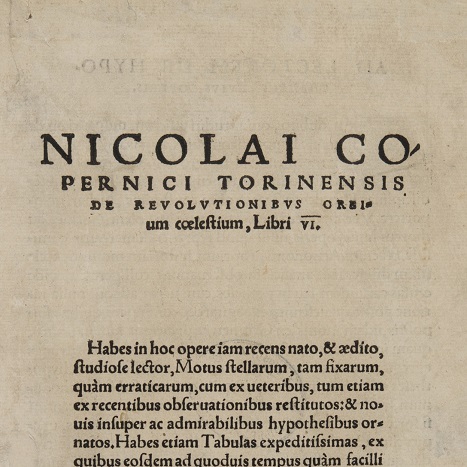
Excerpt from the title page of De Revolutionibus...
It is therefore most certain that Nicolaus Copernicus came from Toruń, a fact he himself repeatedly emphasized. This fact was also aptly emphasized by the author of the Latin inscription placed on the plinth of the Copernicus monument in Toruń, erected by the Germans (!) in 1853, a professor at the Toruń Gymnasium, Brohm. Although he was German himself, he did not disclose Copernicus's supposed German nationality. The inscription reads: "Nicolaus Copernicus Thorunensis, Terrae motor, Solis Caelique stator" (Nicolaus Copernicus, a Toruń native, moved the Earth, stopped the Sun and the Sky).

Nicodemus Frischlin (1547-1590), author of a verse eulogy of Copernicus first published in Mikołaj Reusner's "Icones," a collection of portraits of learned men published in Strasbourg in 1587, also features on Copernicus's Renaissance epitaph in Toruń Cathedral.
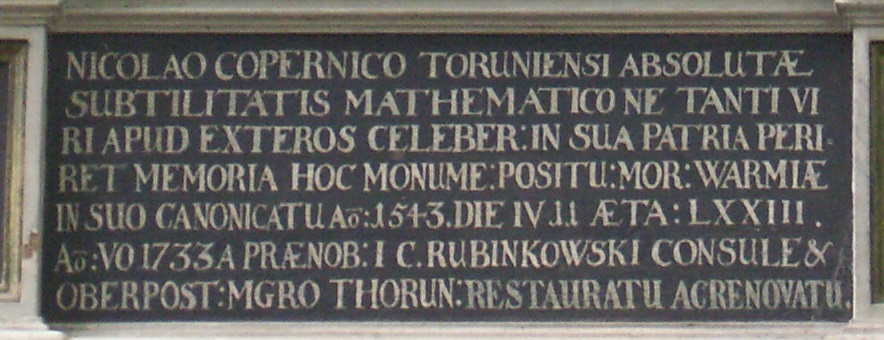
Fragment of an epitaph dedicated to Copernicus, circa 1580, in St. John's Cathedral
Copernicus's friend and student, George Joachim Rheticus, wrote in "Praise of Prussia": "Toruń was once famous for its trade, and now thanks to its great son and my teacher."