
Teutonic Knights
The Teutonic Order and the Origins of Toruń.
Toruń was founded in 1231 by the Teutonic Order. The Teutonic Knights erected a massive castle here, the ruins of which can be visited today. This castle served as a base for the conquest of the pagan Prussians and the establishment of the Teutonic State. The city quickly became an important trading center within the Hanseatic League.
 |
Toruń was the first city founded by the Teutonic Knights in present-day Poland. It was also here that their oldest stronghold in the Chełmno Land was built. From here, the conquest of the pagan Prussians began, and the creation of a powerful state, dynamic and perfectly organized in legal and economic terms, began. This was reflected, among other things, in the power of Toruń, a city that played a leading political, economic, and cultural role in the Teutonic state. When founding their first city, Toruń, the Teutonic Knights did not anticipate that it would soon become such a significant and dynamic urban center, both economically, populously, culturally, and, above all, politically, within the Teutonic state. Initially, Chełmno was envisioned to have a higher status, having been designated the capital city. However, Toruń's exceptionally rapid development during the Teutonic period, apart from favorable privileges for its new German-speaking colonists, was primarily determined by its excellent location – on the navigable Vistula River, at the center of long-distance land trade routes, on the southern edge of the Teutonic state. This location contributed not only to its population and economic growth, but also to its growing political significance. |
The Beginnings of the Teutonic Order
The first mention of the Teutonic Knights running a hospital at the Church of the Blessed Virgin Mary in Jerusalem in the Kingdom of Jerusalem (a state - a papal fiefdom established in 1099 as a result of the First Crusade) appears in documents from 1127 and speaks, among other things, of their subordination to the Knights of St. John. Meanwhile, Peter of Dusburg, author of a 14th-century chronicle of the order, gives 1190 as the founding date of the order. In 1198, it was transformed into a military order, and the following year, Pope Innocent III took under his direct care "the master and brothers of the hospital, which is called the German one." Its main task was to care for the sick and pilgrims to the Holy Sepulcher in Jerusalem and to combat the so-called infidels during the Crusades. The order, which was directly subordinate to the Pope, was headed by the Grand Master and the Chapter, whose seat was Acre in Palestine until 1291, then Venice until 1309, and later (in the years 1309-1457) Malbork.
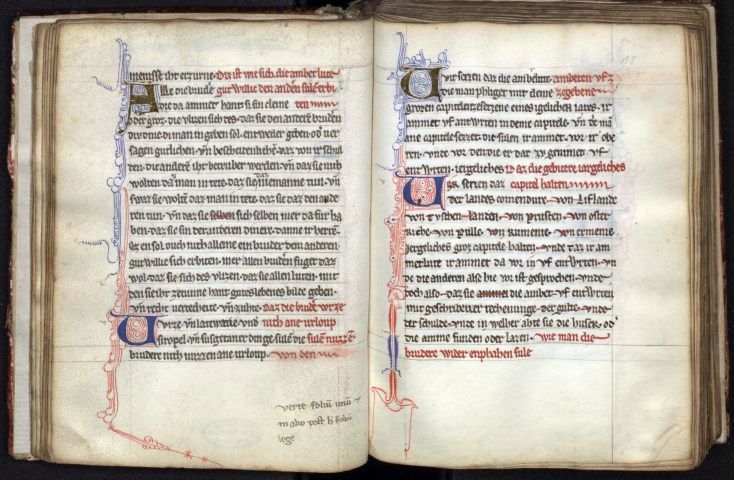
Statutes of the Teutonic Order (Deutschordensstatuten) - a collection of regulations regulating internal life, codified in the mid-13th century. University Library in Toruń. Manuscript in German, French, and Latin, mid-14th century. Parchment. 15.5 x 11.5 cm. Binding contemporary to the manuscript: board, leather, remnants of two brass clasps.
The Teutonic Knights played no significant role in the Holy Land. Faced with the Muslim pressure in Palestine and seeking new territories that would offer the chance to establish their own state, Grand Master Hermann von Salza began efforts to relocate the Order to Europe, especially since the pagan Baltic peoples (Prussians, Lithuanians, Yotvingians, Latvians, Curonians, Livonians, and Estonians) were also becoming interested in the Crusades.
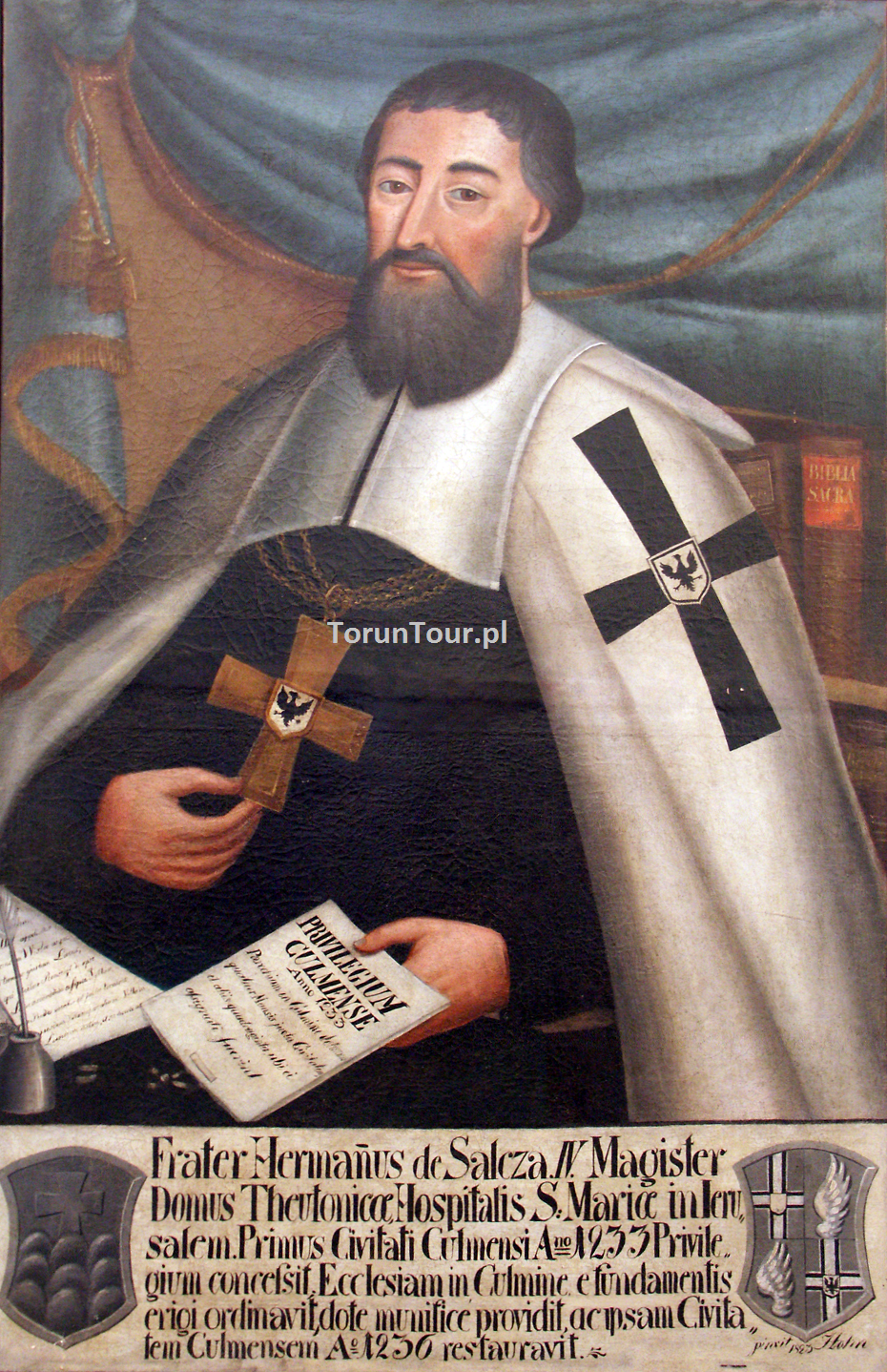
Hermann von Salza (1165–1239) – a trusted associate of Emperor Frederick II, Grand Master of the Teutonic Order from 1210 to 1239, the architect of the Order's power, a distinguished politician and organizer, he played a significant role as an intermediary in contacts between the Emperor and the Pope. With the support of these two most important authorities in medieval Europe, and simultaneously protectors of the Teutonic Knights' missionary activity in Prussia, the Order sought to gain independence from the influence of Polish princes in the 13th century.
On December 28, 1233 or 1232, he issued a charter (the Chełmno Privilege) for the first Teutonic cities: Toruń and Chełmno.
Painting from 1823
In 1211, King Andrew II of Hungary established the Teutonic Knights to defend Transylvania's southern borders against the nomadic Polovtsians. However, when the Teutonic Knights began to pursue their own policies and broke away from royal authority, and the Grand Master surrendered the donated lands to the Pope, Andrew II expelled them from Hungary in 1224-1225, despite vehement protests from the papacy.
An Invitation to Polish Lands
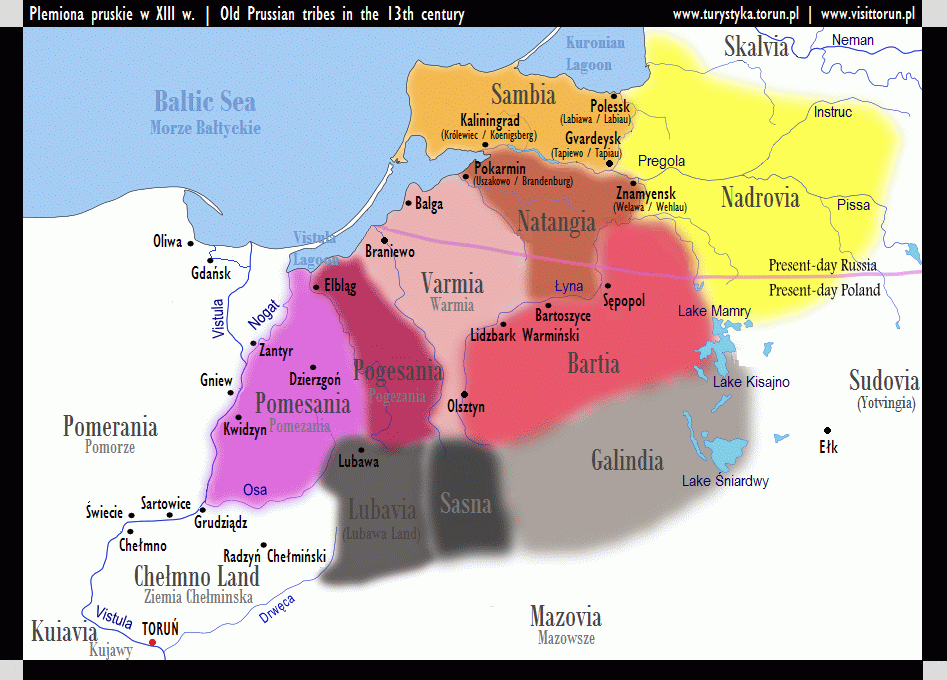
Meanwhile, in the southeastern Baltic coast, Polish princes attempted to baptize the pagan Prussians and bring them under their influence. The Prussians were a Baltic people who settled in late antiquity and the Middle Ages in the historical region known as Prussia, between the lower Vistula and lower Neman rivers. They were culturally and linguistically related to the pagan Lithuanians and Latvians. They were divided into numerous tribes (Pomesanians, Pogessanians, Warmians, Sambians, Natangians, Bartians, Nadrowians, Skalovians, Yotvingians, and Sasini).
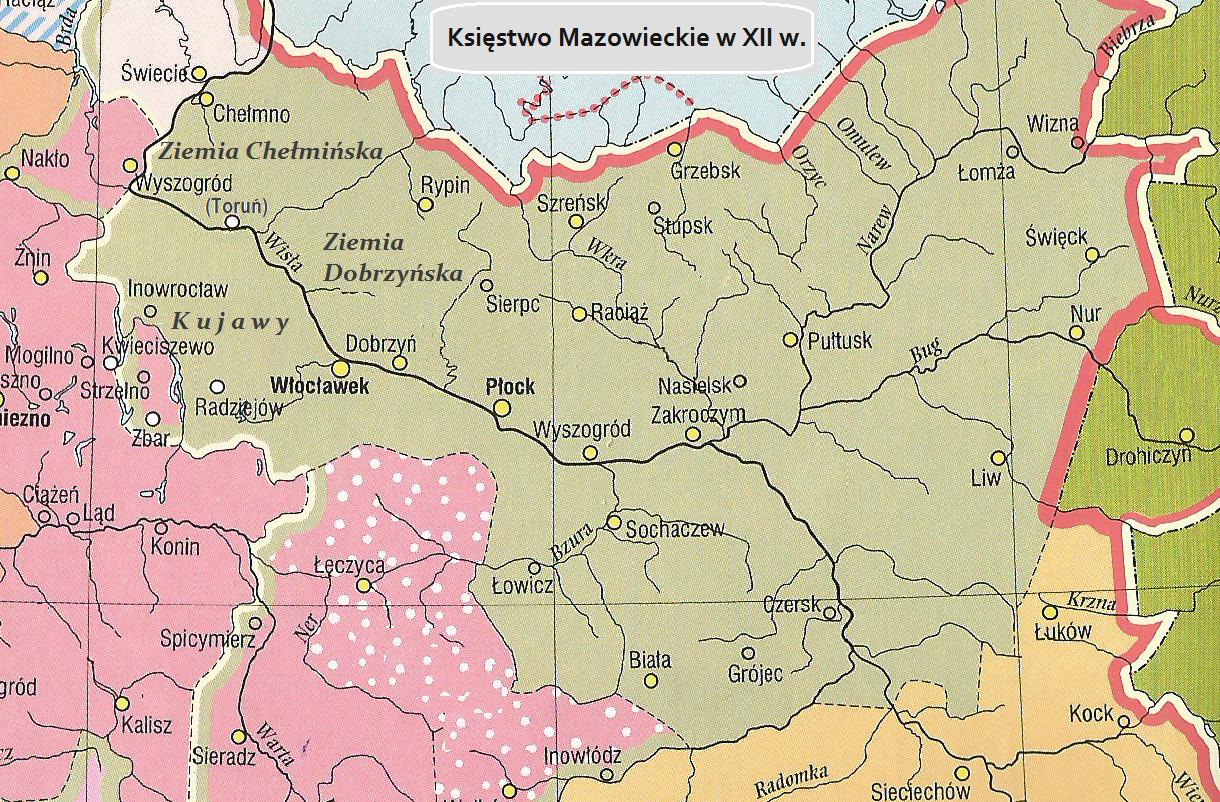
In the Chełmno Land (i.e., in the southwestern reaches of the Prussian-held region, between the Vistula, Drwęca, and Osa rivers), a system of watchtowers was established, based on the main stronghold in Radzyń Chełmiński (conquered in 1015 by the forces of the Polish ruler Bolesław the Brave in Prussia; 57 km North of Toruń). It guarded the border and served as a base for Polish missionaries attempting to Christianize the Prussians. This activity was led by the Archbishop of Gniezno, Henryk Kietlicz, appointed papal legate for Prussian territories in 1210. However, already in 1215, Pope Innocent III established a missionary bishopric for Prussia and granted it to the German Cistercian Christian (from the monastery in Łekno; 120 km West of Toruń), to whom 23 strongholds and 100 villages in the Chełmno Land had been donated in 1222 by Konrad I, Duke of Masovia and Kuyavia. In 1217, Pope Honorius III ordered Polish crusades not to enter Prussian territory without Christian's consent. However, the crusades organized by Christian were ineffective, especially in the face of the intensifying Prussian raids on the Chełmno Land in the 1220s, which at that time (since the feudal fragmentation of Poland in 1138) was part of the Duchy of Masovia (see map). Therefore, the first mention of negotiations to bring the Teutonic Knights, who were being expelled from Transylvania in the Kingdom of Hungary, to the Chełmno Land dates back to 1225. Through these negotiations, the Duke of Masovia hoped to pacify the Masovian-Prussian border, Christianize the Prussians, and perhaps, over time, expand his duchy to include Prussian territories. The idea of bringing the knightly order to the Polish-Prussian border likely originated with Bishop Günter of Płock (at that time, the Chełmno Land was part of the Płock diocese) and Duke Henry the Bearded of Wrocław. Information about this comes from the so-called Golden Bull issued by Emperor Frederick II in Rimini in March 1226 (although it was most likely written in 1235), which laid the legal foundations for the Teutonic State.
The Establishment of the Teutonic State
In 1228, following lengthy negotiations, the Teutonic Knights were summoned by Konrad I, Duke of Masovia and Kuyavia, to fight against the Prussians and to Christianize them. The Grand Master of the Teutonic Knights, Hermann von Salza, an accomplished politician, simultaneously began strenuous efforts to secure for the Order the legal ownership of the Chełmno Land, which he had received as a lease. He wanted to avoid exile, which he suffered from the Hungarian king, who had become aware of the Teutonic Knights' intentions to establish their own statehood in Hungarian Transylvania. The Grand Master of the Teutonic Knights now sought to implement these intentions in the Chełmno Land and Prussia. Consequently, the so-called "Kruszwica Privilege" was allegedly issued in Kruszwica in 1230, in which the Duke of Masovia granted the Teutonic Knights a legal basis for exercising public authority in the Chełmno Land, as well as in the territories later conquered in Prussia. Unlike German historians, Polish historians doubt the authenticity of this privilege, considering it a deliberate forgery prepared by the Teutonic Knights, especially since the original document has not survived.
Following and based on the so-called Kruszwica Privilege - further striving to establish statehood - Grand Master Hermann von Salza brought about the issuance of the papal bull Pietati proximum by Pope Gregory IX on August 3, 1234. This bull confirmed the Teutonic Order's rule over the Chełmno Land and all further territories that would be conquered by the Teutonic Knights in Prussia in the future. Furthermore, to strengthen their independence, the Teutonic Knights were to be subject only to the Pope, free from any other feudal dependence; The document excluded not only the authority of the Piast prince, but also that of the German emperor.
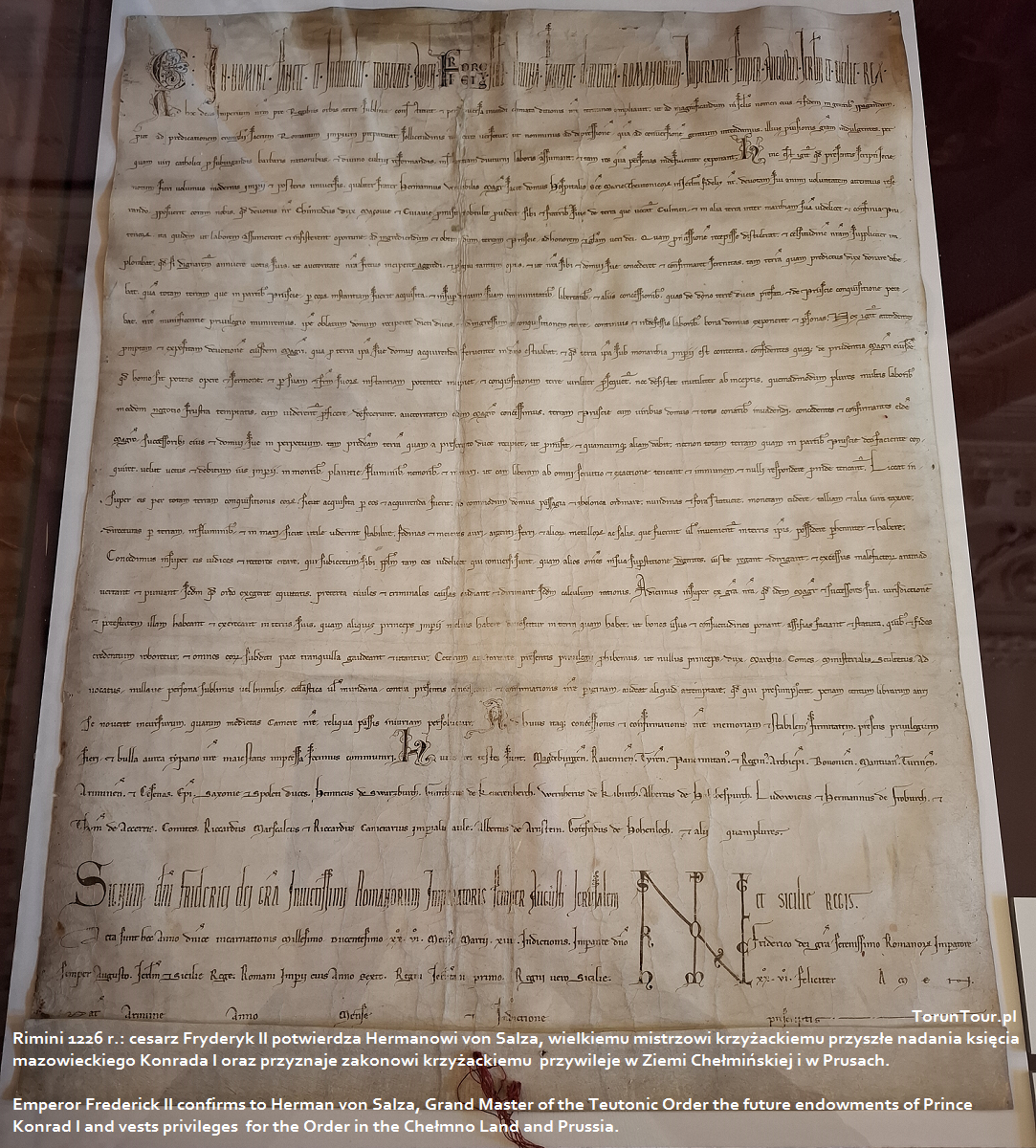 Another fundamental document for the Teutonic Knights was the so-called Golden Bull of Rimini, issued by Emperor Frederick II, also as a result of the efforts of Hermann von Salza (a trusted associate of the emperor). The document is dated March 26, 1226, but was most likely issued in 1235. In this act, Frederick II, recognizing himself as the senior (suzerain) of both the Teutonic Order and the Kingdom of Poland, and simultaneously the supreme ruler of Christian Europe, granted the Teutonic Knights rights to all lands they acquired during their mission in Prussia.
The Teutonic Knights, numbering seven knights and led by Hermann Balk, arrived in the Chełmno Land in the spring of 1230. Initially, however, they settled in the left-bank town of Nieszawa (today's Mała Nieszawka village by Toruń), which was granted to them. In 1231, they crossed to the right bank of the Vistula and founded their first stronghold around a magnificent oak tree - Thorun (today near the village of Stary Toruń). Already on December 28, 1233 or 1232, they founded a city of the same name there, granting it city rights (Chełmno Law).
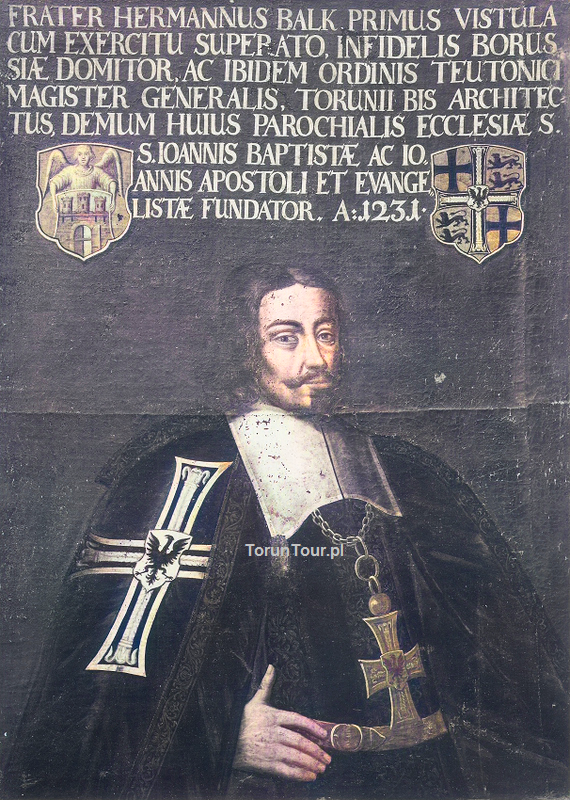
Hermann Balk, National Master for Prussia and Slavdom
portrait donated by Jakub Kazimierz Rubinkowski in 1731
lost during World War II
Why did the Teutonic Knights choose this particular location for their first city?
There is no doubt that the decisive factor was its location on the Vistula River, on the border between the fertile lands of Kuyavia and the Chełmno Land. The Vistula had already been crossed this way on the old route from Kuyavia and Silesia. This route was likely used by newcomers from Kuyavia and Greater Poland to settle the pristine lands of Chełmno Land as early as the 7th century. Merchants traveled this route to the southeastern Baltic Sea in search of amber (one of the branches of the so-called Amber Road). The aforementioned Polish crusades to Prussia also used this route in the early 13th century.
The fall of the Teutonic state
Further wars with Poland (1414-1421 and 1431-1435) led to the impoverishment of the Teutonic state's population and conflict with the dynamically developing cities (Toruń, Gdańsk, Elbląg) and the knighthood, which had fewer powers than the Polish nobility. As early as 1408, at the congress in Malbork, Prussian cities and knighthood first raised complaints about abuses by Teutonic officials concerning trade, crafts, and the administration of justice.
In 1397, the knighthood of Chełmno Land founded the Lizard Society, and in 1440, representatives of the knighthood and Prussian cities, led by Toruń, formed the Prussian Confederation, whose goal was to defend against Teutonic lawlessness. In 1454, the capture of the Teutonic Castle in Toruń sparked an armed uprising, and the members of the Confederation surrendered all Prussian lands (Royal Prussia) to the Polish King Casimir IV Jagiellon, who issued an act of incorporation of Prussia into Kingdom of Poland. The Thirteen Years' War that resulted from these events ended with a Polish victory and the Second Peace of Toruń in 1466. The Order's efforts to overturn the peace treaty led to a new Polish-Teutonic War between 1519 and 1521, which was interrupted by the Truce of Toruń. Grand Master Albert of Hohenzollern secularized the Order and, having adopted Lutheranism, transformed it into a secular principality, the so-called Ducal Prussia, from which he paid fealty to Polish King Sigismund the Old in Kraków in 1525. The Teutonic Knights in Livonia, who became independent from the Teutonic Grand Master at the end of the 15th century, essentially constituted a separate monastic state. Amid internal discord and a weakening of the Livonian Order, the Livonian War broke out in 1588. Facing an unsuccessful defense, the Livonian Grand Master, Gothard Kettler, secularized the order in 1561 and subjugated it to the Polish-Lithuanian Commonwealth.
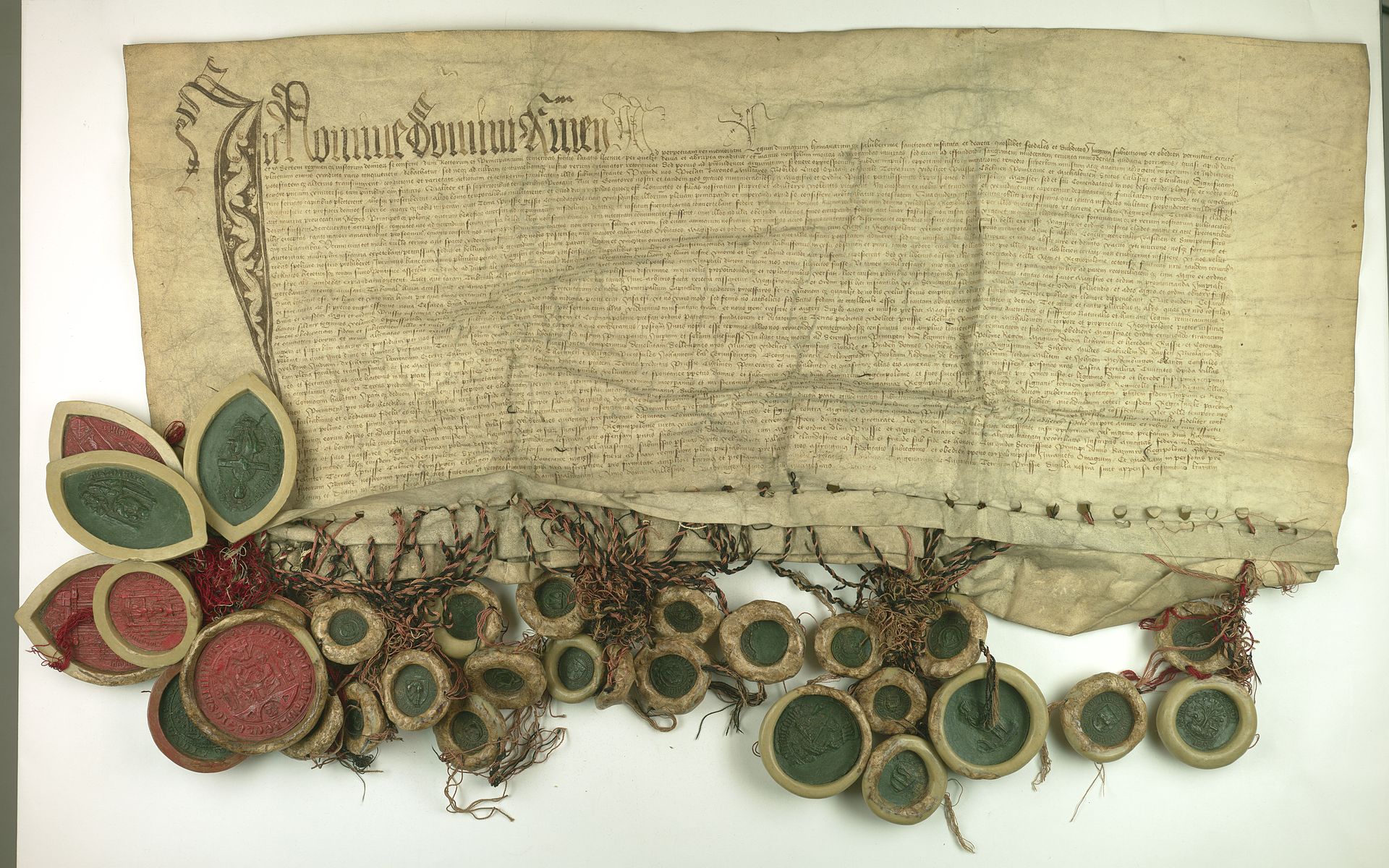
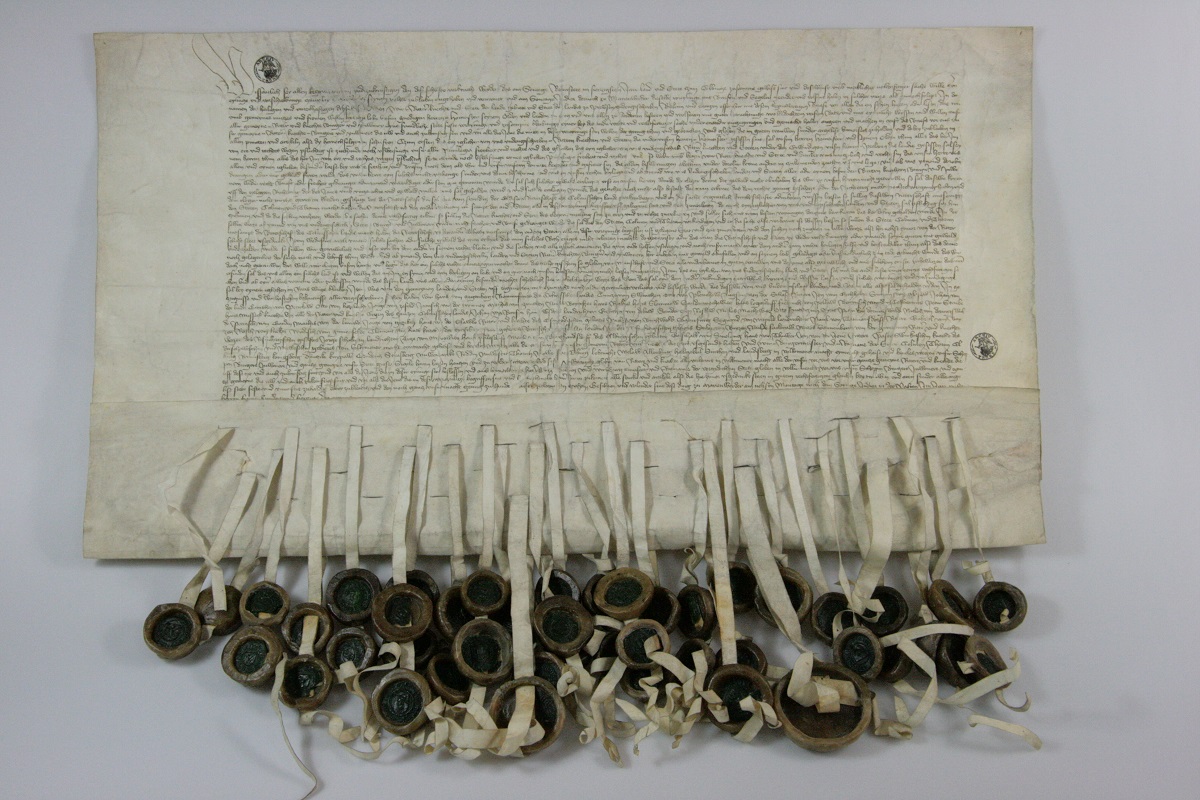
The foundation document of the Prussian Confederation is kept in the State Archives in Toruń

The order, though diminished in size, survived in Germany. In 1809, Emperor Napoleon I dissolved the order, which took refuge in the Habsburg court in Vienna. In 1918, it lost its chivalric character and became a clerical order. It operated illegally in Austria until 1938, after its incorporation into the Reich. In 1947, it was legalized by the Austrian government.
Currently headquartered in Vienna, the Order operates in Austria, Italy, Germany, Belgium, Slovenia, and Moravia. It engages in pastoral, educational, and charitable activities.