Getting around Toruń
On foot
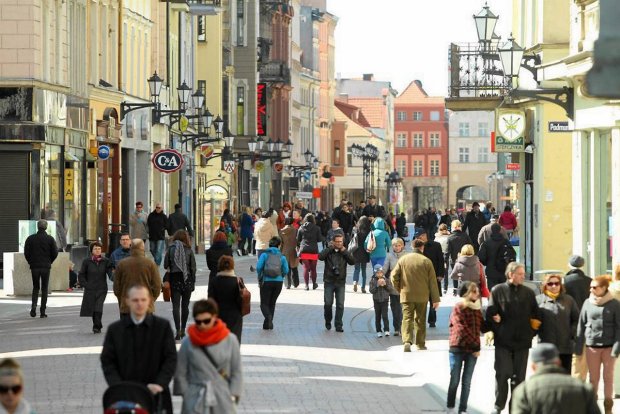
In the case of any historic city full of monuments and Old Town streets, the best solution is to leave your car on a car park and explore on foot. This is the best and most convenient way to explore the entire area of Toruń's Medieval Urban Complex, which covers a total area of approximately 48 hectares and is a UNESCO World Heritage Site. Simply exploring independently, following a guidebook or at your own discretion, while exploring the city's nooks and crannies is not only enjoyable but also efficient. Unfortunately, however, free movement on foot is often hampered and hindered by car traffic, which the Toruń authorities allow, despite the global trend of closing historic city centers and historical sites to cars . Some other attractions and tourist sites in Toruń outside the UNESCO World Heritage Site are also most conveniently accessible on foot, especially Przedmieście Św. Katarzyny (St. Catherine Districs), Przedmieście Bydgoskie, Kępa Bazarowa, and Dybów Castle. In any case, traveling by car in Toruń isn't as troublesome as in other major cities. Long lines and traffic jams are most common during rush hour and on Fridays and occur on streets: Szosa Lubicka, Polna, Kościuszki, Czerwona Droga, Poznańska, and the Piłsudski Bridge. Furthermore, on city streets, watch out for public transport buses exiting minor streets and bus stops, often forcing them to yield. Another inconvenience on Toruń's streets is the savings in lighting that the city has been making for several years by turning on lamps too late in the evening (especially troublesome in winter, when dusk falls earlier and there is increased afternoon traffic on the streets), as well as the functioning of only every second lamp on many streets. |
Public Transport
Timetable >>>
Public transport in Toruń is operated by the Municipal Transport Authority (MZK), which provides (as of 2026): 45 basic daytime bus lines (line designations starting with number 10 and 111 - urban-suburban lines), 7 night lines (designated N... - e.g., N91), and 7 daytime tram lines (line designations starting with number 1). Every city district and some suburban areas have a public transport connection to the city centre. The efficiency of bus connections depends on traffic congestion. During peak hours, buses can be congested by traffic jams. The most important bus stops near Toruń's historic center, where many lines stop, are located at Rapacki Square, Teatralny Square, and St. Catherine's Square. All night lines also meet at Teatralny Square at the same time. Tickets and Prices (2026): Toruń's MZK buses are white. |

Bicycle
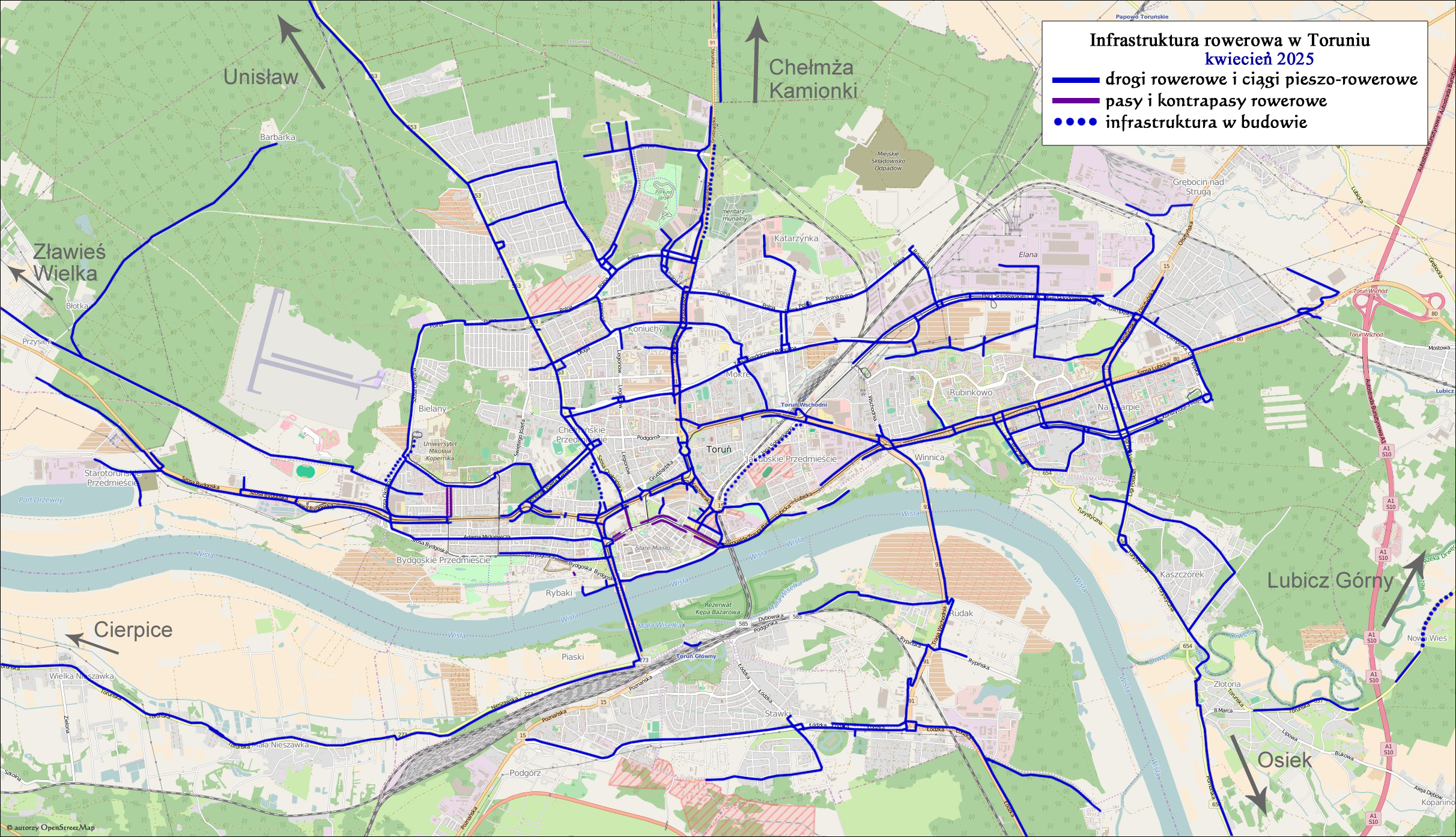
Toruń's marked bike paths do not always form a connected network, and only individual sections appear in various parts of the city. In total, these sections amount to approximately 140 km of bike paths (as of 2025). In many cases, they are not specifically designated, but are created by simply dividing the sidewalk with a painted white line, often interfering with pedestrian traffic. The longest bicycle path (not a dedicated bike path along its entire length) leads from under the railway bridge along Traugutta, Winnica, Szosa Lubicka, Przy Skarpie, and Konstytucji 3 Maja streets. This path consists primarily of sections separated from the sidewalk and a section with car traffic (Winnica Street). It is part of the green Toruń-Brodnica-Radomno cycling trail. For pleasant bike rides, we particularly recommend Barbarka itself and as a starting point for trips to the surrounding area. Toruń City Bike
|